

Daily good news about people, places, things, business, sports, technology and more...no wars, violence, gossip and car chases here - just the GOOD NEWSZ!
Saturday, August 24, 2013

On behalf of his charity work for cancer patients 10 year old Jack Covill-Lowndes is honored by Lego with a life sized statue.


A boy who lost his mother to cancer has had a life-size statue built in his image out of Lego, after the toymaker hailed him as a hero for his charity work.
Jack Covill-Lowndes was honoured for raising thousands of pounds for the hospice that cared for mother Steph.
He beat thousands of other nominees to be named Lego City Hero when his family put his name forward.
The ten-year-old from Wainfleet, Lincolnshire, got to see his likeness – made of 35,000 bricks – when he visited Legoland in Windsor.
‘It’s awesome,’ he said. ‘I can’t stop looking at my statue.’
The figure will remain at Legoland until the end of September before being sent to Jack’s house for him to keep.
His aunt, Tamara Lowndes, said: ‘It’s fantastic – but I’ve no idea where I can keep it. Jack wants it in his bedroom but I think that it’ll make a great garden ornament!’
Harry Harrison, from Lego, added: ‘Jack’s story really captured the essence of a real-life, everyday hero.
‘He’s a real inspiration – and to be immortalised in Lego is befitting of his amazing outlook and achievements.’
Tarra and Bella make a very unlikely couple...
When elephants retire, many head for the Elephant Sanctuary in Hohenwald, Tenn. They arrive one by one, but they tend to live out their lives two-by-two.
"Every elephant that comes here searches out someone that she then spends most all of her time with," says sanctuary co-founder Carol Buckley.
It's like having a best girlfriend, Buckley says - "Somebody they can relate to, they have something in common with."
Debbie has Ronnie. Misty can't live without Dulary.
Those are pachyderm-pachyderm pairs. But perhaps the closest friends of all are Tarra and Bella.
That would be Tarra the 8,700 pound Asian elephant. And Bella. The dog.
"This is her friend," Buckley says, scratching Bella's tummy. "Her friend just happens to be a dog and not an elephant."
"Bella knows she's not an elephant. Tarra knows she's not a dog," Buckley adds. "But that's not a problem for them.
Bella is one of more than a dozen stray dogs that have found a home at the sanctuary. Most want nothing to do with the elephants and vice versa. But not this odd couple.
"When it's time to eat they both eat together. They drink together. They sleep together. They play together," Buckley says.
Tarra and Bella have been close for years -- but no one really knew how close they were until recently. A few months ago Bella suffered a spinal cord injury. She couldn't move her legs, couldn't even wag her tail. For three weeks the dog lay motionless up in the sanctuary office.
And for three weeks the elephant held vigil: 2,700 acres to roam free, and Tarra just stood in the corner, beside a gate, right outside that sanctuary office.
"She just stood outside the balcony - just stood there and waited," says Buckley. "She was concerned about her friend."
Then one day, sanctuary co-founder Scott Blais carried Bella onto the balcony so she and Tarra could at least see each other.
"Bella's tail started wagging. And we had no choice but bring Bella down to see Tarra," Blais says.
They visited like that every day until Tarra could walk. Today, their love -- and trust -- is stronger than ever. Bella even lets Tarra pet her tummy - with the bottom of her enormous foot.
They harbor no fears, no secrets, no prejudices. Just two living creatures who somehow managed to look past their immense differences.
Take good look at this couple, America. Take a good look world. If they can do it - what's our excuse?
"Every elephant that comes here searches out someone that she then spends most all of her time with," says sanctuary co-founder Carol Buckley.
It's like having a best girlfriend, Buckley says - "Somebody they can relate to, they have something in common with."
Debbie has Ronnie. Misty can't live without Dulary.
Those are pachyderm-pachyderm pairs. But perhaps the closest friends of all are Tarra and Bella.
That would be Tarra the 8,700 pound Asian elephant. And Bella. The dog.
"This is her friend," Buckley says, scratching Bella's tummy. "Her friend just happens to be a dog and not an elephant."
"Bella knows she's not an elephant. Tarra knows she's not a dog," Buckley adds. "But that's not a problem for them.
Bella is one of more than a dozen stray dogs that have found a home at the sanctuary. Most want nothing to do with the elephants and vice versa. But not this odd couple.
"When it's time to eat they both eat together. They drink together. They sleep together. They play together," Buckley says.
Tarra and Bella have been close for years -- but no one really knew how close they were until recently. A few months ago Bella suffered a spinal cord injury. She couldn't move her legs, couldn't even wag her tail. For three weeks the dog lay motionless up in the sanctuary office.
And for three weeks the elephant held vigil: 2,700 acres to roam free, and Tarra just stood in the corner, beside a gate, right outside that sanctuary office.
"She just stood outside the balcony - just stood there and waited," says Buckley. "She was concerned about her friend."
Then one day, sanctuary co-founder Scott Blais carried Bella onto the balcony so she and Tarra could at least see each other.
"Bella's tail started wagging. And we had no choice but bring Bella down to see Tarra," Blais says.
They visited like that every day until Tarra could walk. Today, their love -- and trust -- is stronger than ever. Bella even lets Tarra pet her tummy - with the bottom of her enormous foot.
They harbor no fears, no secrets, no prejudices. Just two living creatures who somehow managed to look past their immense differences.
Take good look at this couple, America. Take a good look world. If they can do it - what's our excuse?
99 year old toy store owner Ethel Weiss says the kids keep her going...

The price of the penny candy is up to 10 cents, but not much else has changed at the small toy shop Ethel Weiss has been running near Brookline’s Coolidge Corner for 74 years.
Instead of videogames, kids looking for toys in Irving’s Toy & Card Shop will find what Weiss calls old fashioned toys such as slinkys, silly putty, wood paddle ball, green army men and finger traps.
Weiss would know a thing or two about old fashioned toys.
Friday is her 99th Birthday.
“I never want to retire,” she said Thursday. “I’ll stay here as long as God lets me.”
 To celebrate her birthday, neighbors are bringing a cake to the store at 1 p.m. Saturday.
The near-centenarian has been running her store at 371 Harvard St. just outside of Coolidge Corner in Brookline’s JFK Crossing neighborhood since 1939. What started as a small grocery and school supply store transitioned into a toy and card shop after Weiss and her late husband Irving Kravetz purchased the small shop. Kravetz passed away in 1960 and Weiss’s second husband, Abe Weiss, has also passed away.
But she has kept the store running year after year while the economy or changes in the marketplace forced other toy stores to close.
Weiss said she credits the survival of her business to low overhead and great customers. She lives next door and the store keeps her busy, especially during the school year when kids are attending the neighboring Edward Devotion School.
Her love for the kids is what keeps her going, Weiss said.
“The people around here are wonderful,” she said.
Weiss said she doesn’t sell unsafe items, refuses to sell things like candy cigarettes because she thinks they send the wrong message, and doesn’t sell many expensive toys.
 When the kids come in to buy candy, she said she makes them do the math to add up how much they are spending, and she makes the kids read her list of tips she calls “Thoughts for a Happier Life” that includes sage advice, such as “Show appreciation. Try to be a good role model,” and “Don’t try to be perfect. Just do the best you can.”
“I make all the kids read it because I want them to do the right thing,” Weiss said.
This time next year Weiss said she hopes she’s celebrating her 100th birthday and is still working at the store.
“It’s more fun being here than at home,” she said.
Friday, August 23, 2013

23 year old Patrick McConlogue gave a homeless man a choice between $100 in cash or free computer programming lessons...

In an interview with Business Insider, the 23-year-old said he simply wanted to give the homeless man he sees on his way to work each morning a choice: He could take $100 in cash or get the chance to learn a new trade. If the man rejected the money, McConlogue would provide him with a laptop and coding books, as well as one hour of coding lessons a day for two months.
The whole thing caused a lot of people in the tech world to blast McConlogue for being insensitive toward homeless people and turning the man into his pet project.
But it looks like McConlogue will get the last laugh.
The homeless man, who McConlogue dubbed The Journeyman Hacker, is named Leo. Today, he took McConlogue up on his offer; he's going to learn to code.
In an update on Medium today, McConlogue writes:
It turns out Leo is a genius particularly concerned with environment issues. As I sat there becoming increasing stunned, he rattled off import/export prices on food, the importance of solar and green energy, and his approval for “efficient public transportation initiatives [referring to NY’s new Citibike]”. He is smart, logical, and articulate. Most importantly, he is serious. It’s up to him if dedication is also his gift.
The next step? For the next two months, McConlogue will leave for work an hour earlier to meet with Leo for a coding lesson. McConlogue said he overnighted him a Chromebook with access to Code Academy, three levels of coding books, and a solar charger. He said he has yet to find something to "hide" the laptop in.
McConlogue believes that within eight weeks, Leo will have the skills necessary to be able to position himself as a freelancer. It's an experiment for both men.
Tomorrow, McConlogue says there will be an update from Leo himself on Medium. He also created a Facebook page for Leo and the project.
True hero: Antoinette Tuff talks distraught gunmen into giving himself up...
Atlanta (CNN) -- A man slips behind someone else into a
packed elementary school with an AK-47-type weapon. He goes into the office and
shoots at the ground, then darts between there and outside to fire at
approaching police.
So what do you do?
If you're Antoinette Tuff, who works in the front office at
Ronald E. McNair Discovery Learning Academy just outside Atlanta, you don't
run. You talk. You divulge your personal struggles to the gunman, you tell him
you love him, you even proactively offer to walk outside with him to surrender
so police won't shoot.
And then the nightmare ends with the suspect, later
identified as Michael Brandon Hill, taken into custody and no one inside or
outside the Decatur school even hurt, despite the gunfire.
"Let me tell you something, babe," Tuff tells the
dispatcher, Kendra McCray, at the end of the dramatic 911 call that recounts
her minutes of valor and terror. "I've never been so scared in all the
days of my life. Oh, Jesus."
This brief outburst of emotion, moments after police entered
the school Tuesday, was in stark contrast to her cool, calm demeanor as heard
earlier on that 911 call.
As a go-between, she relayed his demands that police refrain
from using their radios and "stop all movement," or else the suspect
would shoot.
"He doesn't want the kids, he wants the police, so back
off," she said in the call. "What else, sir? He said he don't care if
he die, he don't have nothing to live for, and he said he's not mentally
stable."
By the end -- with police themselves having never directly
talked to him -- Tuff and the gunman were talking about where he would put his
weapon, how he'd empty his pockets and where he'd lie down before authorities
could get him.
37 year old Anthony Yahle gets a second chance at life after being pronounced dead by doctors...
When 17-year-old Lawrence Yahle learned his father was dead earlier this month at Kettering Medical Center in Ohio, he ran down the hall to see nurses around his father's body. They weren't trying to revive him anymore.
Distraught, Lawrence pointed and shouted, "Dad, you're not going to die today."
Moments later, Anthony Yahle's heart monitor showed signs of life, Dr. Raja Nazir, his cardiologist at Kettering Medical Center, told ABCNews.com. It wasn't a regular heart beat, but once or twice a minute, the monitor would pick up tiny electrical movements.
"When I looked at the electrical activity, I was surprised," Nazir said. "I thought we'd better make another effort to revive him."
Nazir gave one of Yahle's hanging medicine bags a squeeze to restore his blood pressure and the team began working on him again.
"Very slowly, the heart rate was picking up," Nazir said.
That was more than a week ago, on Aug. 5. Doctors thought Yahle, a 37-year-old diesel mechanic, would need a heart transplant or be in a vegetative state the rest of his life, but he's home resting and seems fine.
"I'm calling it a miracle because I've never seen anything like it," Nazir said.
Yahle's near-death experience started at 4 a.m. that day, when his wife, Melissa Yahle, woke up and realized his breathing didn't sound right. Melissa, who has been a nurse for seven years, said she tried unsuccessfully to wake him up.
Melissa and Lawrence performed CPR until an ambulance could arrive, and first responders found a heartbeat after shocking Yahle several times.
At the hospital, doctors expected Yahle's arteries to be clogged, but they were clear. Things were looking positive until later that afternoon, when Yahle's heart stopped.
He "coded" for 45 minutes as doctors tried to revive him, but eventually Nazir realized it was time to call the time of death.
"We looked at each other," Nazir said. "We'd given him all the medicine we had in our code cart. At some point, you have to call it off."
Nazir said he wasn't sure exactly how long Yahle was "dead," before Lawrence ran down the hall to tell his father he couldn't die that day.
"Suddenly that trickle of a thing came back," Nazir said. "We were lucky we saw and reacted to it, and that brought him back."
Nazir said it was "mind boggling." Melissa said she, Lawrence and the people from their church who were praying with them witnessed a miracle.
Yahle was transferred to Ohio State University, and he returned home to West Carrollton on Aug. 10 with a defibrillator in his chest. He doesn't remember any of the experience after he went to bed on Aug. 4.
"He doesn't have one broken rib," Melissa said. "He's not sore. These are things that just clinically don't happen."
Yahle is set to go back to work on Monday, and doctors may do a heart biopsy to find out more about what happened.
Thursday, August 22, 2013

Never Give Up: After 29 tries foster child Jed Maddalon finds his "forever home"...
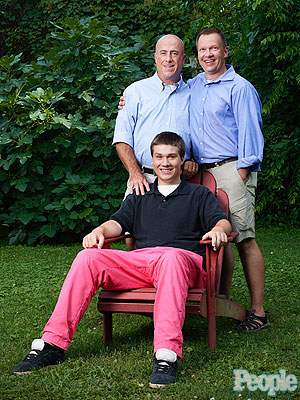
There are cases of hellish abuse – and then there was Jed.
Born to severely mentally ill parents, he was found in rural Robeson County, N.C., at age 3, emaciated and chained to a bed, eating from a dog bowl on the floor. Child protective services tried to place him in foster homes – some good and others troubled – but the traumatized youngster stole, attacked his foster parents and ran away.
"One time Jed came to my office, crying and said, 'Won't I ever have a family? Won't anybody ever love me?' " says Denise Little, a social worker, who worked with Jed for years.
By the time he was 13, Jed had cycled through 29 families, including four who had initially wanted to adopt him. After his 14th birthday, therapists at the Alexander Youth Network (AYN), the Charlotte, N.C., treatment center where Jed had stayed on and off since he was 8, reluctantly concluded there was no more they could do for him and he was transferred to a mental institution.
When AYN volunteers Billy Maddalon, 46, a businessman who had himself spent two years at the facility during his own troubled youth, and his partner, Brooks Shelley, 46, heard Jed was being sent away, they knew they had to try to help him.
"It just felt like somebody had to save him," says Maddalon. "I said, 'We're the right people.' Even if 29 families thought the same thing, we're naive and optimistic. We believe in happy endings."
In October of 2008, after they were certified as foster parents, Jed came to live with Maddalon and Shelley.
"That first night we made spaghetti," Maddalon recalls. "He sat underneath the table and ate with his fingers. He didn't know how to bathe, couldn't write his name."
Despite finally living in a stable home, Jed often ran away.
"I was nervous. I didn't trust anyone," he says. "I didn’t think anyone would ever want me. Everybody had been saying I was a lost cause and I believed it."
But his parents didn't give up, formally adopting him two years after he came to live with them.
"One time he jumped on a train," says Shelley, "and we tracked him on the computer using the GPS on his phone. But when he ran away he would call around dinnertime and ask to come home."
Today, a high school junior at 19, Jed hopes to attend North Carolina State, Maddalon's alma mater.
"No matter how much I acted up, they said I wasn’t going anywhere," says Jed. "They gave me my first birthday party. It’s pretty straightforward. They care about me. I’m not going anywhere. This is my forever home."
U.S. Soldier Ty Carter to receive the nation's highest honor after giving military service a second try...
(CNN) -- When Spc.Ty Carter first arrived in Afghanistan, he
took one look at his surroundings and thought, "This is a death
trap."
He would soon learn just how right he was.
Combat Outpost Keating was a sitting target for nearby
Taliban insurgents: It sat deep within a valley, surrounded by mountains.
The American soldiers stationed there knew it was only a
matter of time before something bad happened. "We just didn't know when,"
Carter said.
When it did, the assault would set in motion a chaotic chain
of events that had every soldier certain he would not make it out alive.
Eight American soldiers died on October 3, 2009. Many of the
45 others who survived, including Carter, struggle with the guilt that they
couldn't save more lives.
Yet Carter's daring efforts to rescue his fellow soldiers in
the face of imminent death earned him the nation's highest military decoration,
the Medal of Honor, which he will receive on Monday at a White House ceremony.
Now Staff Sgt. Ty Carter, 33, will join another survivor of
that battle, former Army Staff Sgt. Clint Romesha, who received the award
earlier this year. It marks the first time in nearly half a century that two
living soldiers from the same battle received the Medal of Honor.
To Carter, it's a bittersweet award.
"It just brings back all those memories of what he had
to go through," explained his wife, Shannon Derby.
Discharged from the Marines
Carter was a loner as a teenager. He didn't have a lot of
friends. His older brother Seth had a knack for getting into trouble, and Ty
followed in his footsteps for awhile before his mother kicked Seth out of the
house.
Not exactly hero material, he says.
Carter joined the Marines in 1998, spending five years in
the service until a fight with a roommate led to his demotion. Two months
later, he was honorably discharged.
So, it was back to civilian life, something that left Carter
restless and bored. He bounced across the country from job to job: more than a
dozen stints in five years, everything from a yacht repairman to a tow-truck
operator.
He was supporting his daughter after his first marriage
ended. But in every job, something was always missing.
John Stamos flies under the radar to pay a special visit to 19 year old Kaitlyn Dobrow who is recovering from a devastating bout of bacterial meningitis

John Stamos has a giant heart.
The "Full House" alum brought a smile to Kaitlyn Dobrow's face when he visited the 19-year-old, who is recovering from a devastating bout of bacterial meningitis, this week in Los Angeles.
Stamos, who now stars on TV's "Necessary Roughness," took time out of his busy schedule to hang with the hospitalized teen, bringing a smile to her face, as you can see in this snapshot. "I'm ONLY doing this cause they asked. I said no press," he wrote, along with the photo he Instagrammed on Tuesday. "But this story is a must read- plus me and Katie have a date to Disneyland."
The Orange County, California, resident has since undergone 20 surgeries and has been recovering in the burn center of UC Irvine Medical Center. According to a Facebook pagetracking her progress, her skin grafts are healing and she is expected to be moved to rehab on August 16 ― six months after she was first hospitalized.The 49-year-old actor, who humbly didn't want to publicize his act of kindness, linked to a story about Dobrow, whose life was turned upside down in February when a bout with what she thought was the common flu turned out to be potentially deadly meningococcal meningitis. The only way doctors were able to stop the infection was by amputating her arms and legs.
"She's very nervous about leaving the hospital, where she feels safe and knows and loves the staff," the most recent update said. However, "she'll do great once she gets to rehab."
We're sure Dobrow's Disney date with Stamos will serve as inspiration.
Stamos isn't the only one showing support to the teen. Donations for her medical expenses are being collected in a Gift Forward campaign, which you can read more about here.
Wednesday, August 21, 2013

Despite being legally blind Pete Gustin has become radio station WEEI's long time voice over guy...
Listeners to Boston's sports radio station WEEI are likely familiar with the work of Pete Gustin. His is the deep, smooth voice heard in many of the station's show opens, promos, and in the many amusing "bits" created to lampoon sports personalities and even WEEI's on-air personnel.
What most die-hard listeners (including this one) didn't know is that Gustin is legally blind. Think about that for a second. The guy who reads copy for a living... is legally blind.
Gustin has produced a fascinating video that shows how he's become a rising star in the voice-over world -- without the ability to see a script or a teleprompter. Take a look.
Pilots bang a U-Turn to pick up 11 year old cancer patient Inbar Chomsky and bring her to camp...

An El Al Airlines pilot made an extraordinary gesture toward an 11-year-old girl who had been removed from a flight from Israel to New York City after she lost her passport.
Inbar Chomsky of Rehovot, Israel, planned to attend Camp Simcha in Glen Spey, New York for children who suffer from cancer and other hematologic illnesses. The camp program is offered by Chai Lifetime, a non-profit international organization.
On August 8, all 36 children excitedly boarded the El Al flight for their two-week trip to the United States. After they underwent a pre-flight medical examination and were seated, the flight crew began collecting passports, while the plane prepared for takeoff. However, during the process, a flight attendant realized that Chomsky’s passport was missing.
The crew began frantically searching the aircraft but no one could find it. “It was pretty chaotic,” Rabbi Scholar, executive vice president of Chai Lifelime told Yahoo! Shine. “There is so much medical clearance that takes place before these kids are allowed to get on an international flight and to have this happen to a little girl who has already gone through so much was unfortunate.”
The search party expanded. The ground crew boarded the plane to help out and the airport staff scoured the area between the boarding gate and the plane. Passengers were getting restless, and with time running out, the pilot stepped out of the cockpit and informed Chomsky that without a passport, she wouldn’t be able to fly to New York. They called her mother to pick her up.
“Everyone was very emotional,” said Rabbi Scholar. “There wasn’t one person on that flight who wasn’t in tears or upset for this little girl. However, there was nothing that could be done.”
The plane had almost reached the runway when someone located Chomsky’s passport in the backpack of a fellow camper. Immediately, the pilot alerted the control tower, ground crew, and El Al’s offices to see if he could retrieve Chomsky. After 30 minutes of negotiations, the pilot turned the plane around and picked her up, to the cheers of the other passengers.
Although Yahoo! Shine could not reach an El Al spokesperson for comment, the airline sent a statement to the Times of Israel that read, “Planes rarely return to the gate after departing. The plane was on its way to the runway, when the passport was found on the plane. After consulting with El Al crew on the plane and El Al staff at the airport the decision was made and the plane returned to pick up Inbar. El Al was honored and proud to help Inbar’s dream to go to the camp in the USA come true. We wish Inbar full recovery and health.”
Inbar Chomsky of Rehovot, Israel, planned to attend Camp Simcha in Glen Spey, New York for children who suffer from cancer and other hematologic illnesses. The camp program is offered by Chai Lifetime, a non-profit international organization.
On August 8, all 36 children excitedly boarded the El Al flight for their two-week trip to the United States. After they underwent a pre-flight medical examination and were seated, the flight crew began collecting passports, while the plane prepared for takeoff. However, during the process, a flight attendant realized that Chomsky’s passport was missing.
The crew began frantically searching the aircraft but no one could find it. “It was pretty chaotic,” Rabbi Scholar, executive vice president of Chai Lifelime told Yahoo! Shine. “There is so much medical clearance that takes place before these kids are allowed to get on an international flight and to have this happen to a little girl who has already gone through so much was unfortunate.”
The search party expanded. The ground crew boarded the plane to help out and the airport staff scoured the area between the boarding gate and the plane. Passengers were getting restless, and with time running out, the pilot stepped out of the cockpit and informed Chomsky that without a passport, she wouldn’t be able to fly to New York. They called her mother to pick her up.
“Everyone was very emotional,” said Rabbi Scholar. “There wasn’t one person on that flight who wasn’t in tears or upset for this little girl. However, there was nothing that could be done.”
The plane had almost reached the runway when someone located Chomsky’s passport in the backpack of a fellow camper. Immediately, the pilot alerted the control tower, ground crew, and El Al’s offices to see if he could retrieve Chomsky. After 30 minutes of negotiations, the pilot turned the plane around and picked her up, to the cheers of the other passengers.
Although Yahoo! Shine could not reach an El Al spokesperson for comment, the airline sent a statement to the Times of Israel that read, “Planes rarely return to the gate after departing. The plane was on its way to the runway, when the passport was found on the plane. After consulting with El Al crew on the plane and El Al staff at the airport the decision was made and the plane returned to pick up Inbar. El Al was honored and proud to help Inbar’s dream to go to the camp in the USA come true. We wish Inbar full recovery and health.”
Eye test could detect Alzheimer's disease 20 years in advance...
Doctors may one day use eye tests to detect the very early stages of Alzheimer’s disease, according to new research.
Non-invasive retinal testing is now being trialled and could help flag up the condition by alerting doctors to the presence of amyloid plaque deposits, a known marker of the disease.
Testing could mean that patients are diagnosed or are at least flagged up as high-risk up to 20 years before noticeable symptoms begin, helping patients get treatment before memory loss develops.
Experts generally accept that amyloid plaques - a type of protein deposit - in the brain are a key marker of the disease.
Neurologists have also long believed that there is a correlation between the amount of amyloid in the eye and amyloid in the brain.
The arguement for this is strong because the retina is formed from the same tissue as the brain when a foetus is developing in the womb.
To confirm this theory, two tests - the Retinal Amyloid Index by NeuroVision and the Sapphire II by Cognoptix - have been developed and trials are underway, according to a report by Primary Care Optometry News.
Tuesday, August 20, 2013

Life's a Beach - architect brings the library to the beach in Bulgaria...

Even in these digital times, taking a book to the beach remains one of the most popular holiday pastimes.
Now a German architect has come up with a novel way of getting an extension.
Bulgaria’s Black Sea resort of Albena now boasts having its own beach library – with books ready to be read come rain or shine.
Herman Kompernas, the library’s architect and project manager, explained: “We found a material that is very resistant to sun and water. We also found a stabilisation method very quickly. We chose a sort of palette construction for under the library to make it very stable against the wind.”
The library’s stock of over 2,500 volumes in more than 10 languages is so far proving a hit, especially because all books on the shelves can be borrowed for free.
“I think there is a wide choice of books and authors. Also, the library is getting richer because of our guests who leave their own books when they go home for others to read,” said Yovka Strashilova, Albena’s deputy manager.
The special open-air library is made of material resistant to strong wind and extreme sun, and in rainy weather the books will be protected by vinyl, fastened with a zipper.
9 year old Josh Pita is Standing up to Cancer and playing football too!
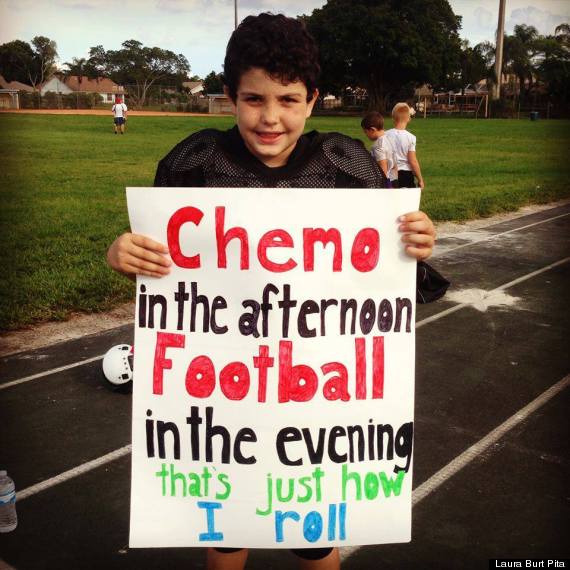
Josh was diagnosed with acute lymphoblastic leukemia, or ALL, in 2010.
But he's tackled way more than cancer since then. In 2012, he was even able to return to the football field.
Stand Up To Cancer shared this picture of Josh on Thursday after his mother, Laura Burt Pita, posted it to Facebook.
"Fortunately, [Josh's] surgeon took the time to get to know Josh and his love of football, and placed his port where it is protected by his shoulder pads" Pita wrote. "[Josh] earned the starting right tackle position. If that's not standing up to cancer, I don't know what is! I'm so proud of my sweet boy!"
Since Thursday, the inspirational sign has received more than 74,000 likes and 4,000 shares.
"My 5-year-old son was diagnosed last year with A.L.L leukemia and his best joy was always watching his big brother play football!" James Henry commented on Facebook. "This inspires me to let him after his treatment is over! Due to where his port is now! Awesome job Josh!"
According to Josh's fundraising page, chemotherapy is a just one part of their family's routine. He also goes to school, plays baseball, and likes to go camping.
"I now help parents of newly diagnosed [patients] find their way through the confusion and despair that encompass a pediatric cancer diagnosis," Pita added. "We have found our way, and life is good."
And on August 7, she shared more good news on Facebook:
Keep on rollin', Josh!
FRED Buses for kids - Fun, Read, Eat, Dream...roll through the streets feeding hungry kids during the summer

FEDERAL WAY, Wash. -- Four days a week this summer, lime green school buses loaded with games, books and computers rumbled through low-income neighborhoods south of Seattle. Their aim wasn't just to entertain kids – but to feed them.
"It's fun here," said 10-year-old Mia Tolo on a recent afternoon outside one such bus, where she played Chutes and Ladders with her friend Anita Velasco after they had pizza, bananas and milk.

Department of Agriculture officials and community leaders cite the rolling rec centers, covered in cartoon frogs, as a novel approach in the federal government's push to get meals to millions more schoolchildren when they need it most.

About 21 million U.S. students receive free or reduced-price lunches during the school year, but only a fraction of them, 3.5 million according to most recent statistics, are fed regularly over the summer.
"That's a drop in the bucket compared to how many need it," said Bill Ayres, executive director of Why Hunger, a nonprofit that works to expand food programs.
In recent years, the federal government has been pushing its spending toward mobile food programs, feeding hungry kids in parks, recreation centers and even their homes. There are now 42,000 sites that provide summer meals, and the 3,000 locations added this year represents the largest increase the program has seen, said Undersecretary Kevin Concannon, with the food and nutrition division of the USDA.
That growth came as Agriculture Secretary Tom Vilsack announced in June a goal of serving 5 million more meals to eligible youngsters this summer. Government officials said an assessment of that goal won't be available until at least next year, but officials pointed to the thousands of new sites as reasons for optimism.
In Federal Way, Wash., where more than half of the school district's 22,000 children receive free or reduced-price lunches, about 900 students receive meals at summer school programs and community centers. Another 400 were fed from the trio of FRED buses – for fun, read, eat, dream – roaming the city from Monday to Thursday each week.
Subscribe to:
Posts (Atom)